 The Hearts of Gold team
September 13, 2026 · 4 min read
The Hearts of Gold team
September 13, 2026 · 4 min read
A new litter of golden retriever puppies has arrived at Hearts of Gold, and every one of them is being raised for the same thing: a working life as a service or therapy dog. The vests do not fit yet — the straps are pulled to their last inch — but the vest was never the hard part to grow into.
What they are being raised for
Two paths run out of a litter like this one. A service dog is task trained to mitigate one person's disability — under the law it is closer to medical equipment than to a pet, and the specific tasks are the whole point of it. A therapy dog belongs to a place rather than a person: a school, an office, a hospital, a care facility, where the dog is simply there on the ordinary days and the hard ones alike.
None of that is settled today. Right now these puppies are learning what a hand feels like and what a floor sounds like, and that is the entire curriculum. But one day one of these paws could walk into a school, settle beside a hospital bed, or tell a handler that a seizure is coming — and one tiny puppy is where every bit of that starts.
Which path a dog takes is not something we decide in advance. We raise our puppies with dream jobs in mind and then let them show us who they want to be — some are built for service work, some are happiest doing therapy visits, and the dog is usually clearer about it than we are.

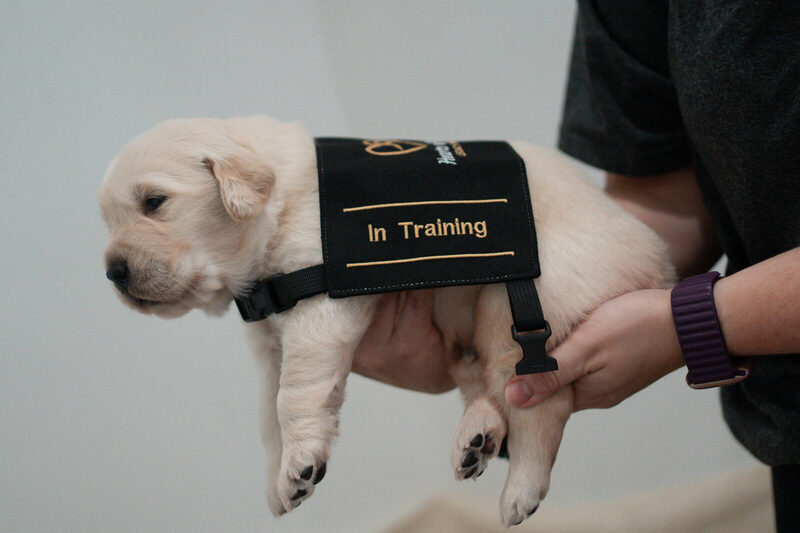
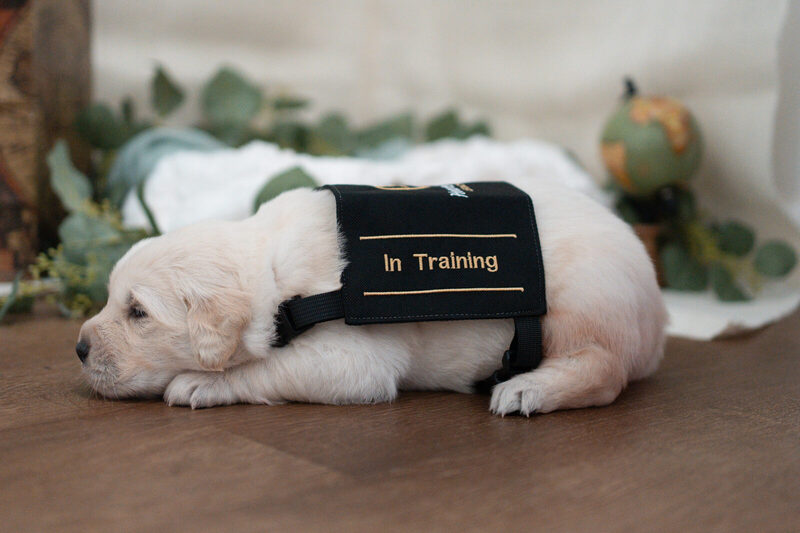





These first months are the ones donations actually cover. Give to the Puppy Fund and you pay for the food, the vet visits and the training equipment behind every photograph above.
What happens next
A puppy's first job is an ordinary life. Every future working dog spends roughly sixteen to eighteen months in a volunteer raiser's home — doorbells, thunderstorms, car rides, school pickups, a stranger's voice in a queue — with the organization carrying the food, the veterinary care and the training costs for that whole stretch.
Advanced task work comes after that, and by the time a dog is ready to be placed, roughly two years have gone into it. Then the leash changes hands, and the dog is free to its recipient. Two years is a long time to look at a photograph of a sleeping puppy and see a working dog. It is the job anyway.
How to be part of it
There are two honest answers to “how do I help with this.” The first is to raise one. No experience is needed — we teach you everything and stay close the entire time, and what the commitment actually involves is laid out on our puppy raising page. It is the single biggest gift anyone gives this organization.
The second is to give to the Puppy Fund, which carries this litter's food, veterinary care and training equipment right now. Two years of raising, training and placement adds up to a number most people do not expect, and we wrote the honest version of it down in what a service dog actually costs. Every gift is a piece of that, and every piece keeps the next placement free to the person waiting for it.
Golden retriever service dogs in Missouri
The dogs we raise are golden retrievers, and Hearts of Gold Legacy Canines raises, trains and places service dogs from Cape Girardeau, across Southeast Missouri. How each side of the work fits together — service dogs, therapy dogs, puppy raising — is set out on our programs page.
For now, though, there is a new litter learning that the world is safe and people are good. Everything else follows from that.
Keep reading: Therapy Dog vs Service Dog: What's the Difference? · How to Become a Puppy Raiser